
I stand in kitchens, my canvas of chrome and grain, and my eyes are so often met with a chorus of the same tired shades. They shout where they should whisper, they clash where they should harmonize. The countertop—that broad, defining plane—holds more power than we grant it. It is the stage upon which the daily drama of coffee and cuisine unfolds, and its color sets the tone for the entire room. Yet, so many are dressed in hues that feel like a costume from a play long since closed. From a stark, unforgiving white to a muddied, melancholy brown, these are the colors that have overstayed their welcome in the modern hearth. But even the most challenging palette holds a secret melody, if only one knows how to listen and compose around it.
The Clinical Chill of Stark White
 :max_bytes(150000):strip_icc():format(webp)/GettyImages-1213185238-4bbd6b85812a427fa13ab8d741fd0abd.jpg)
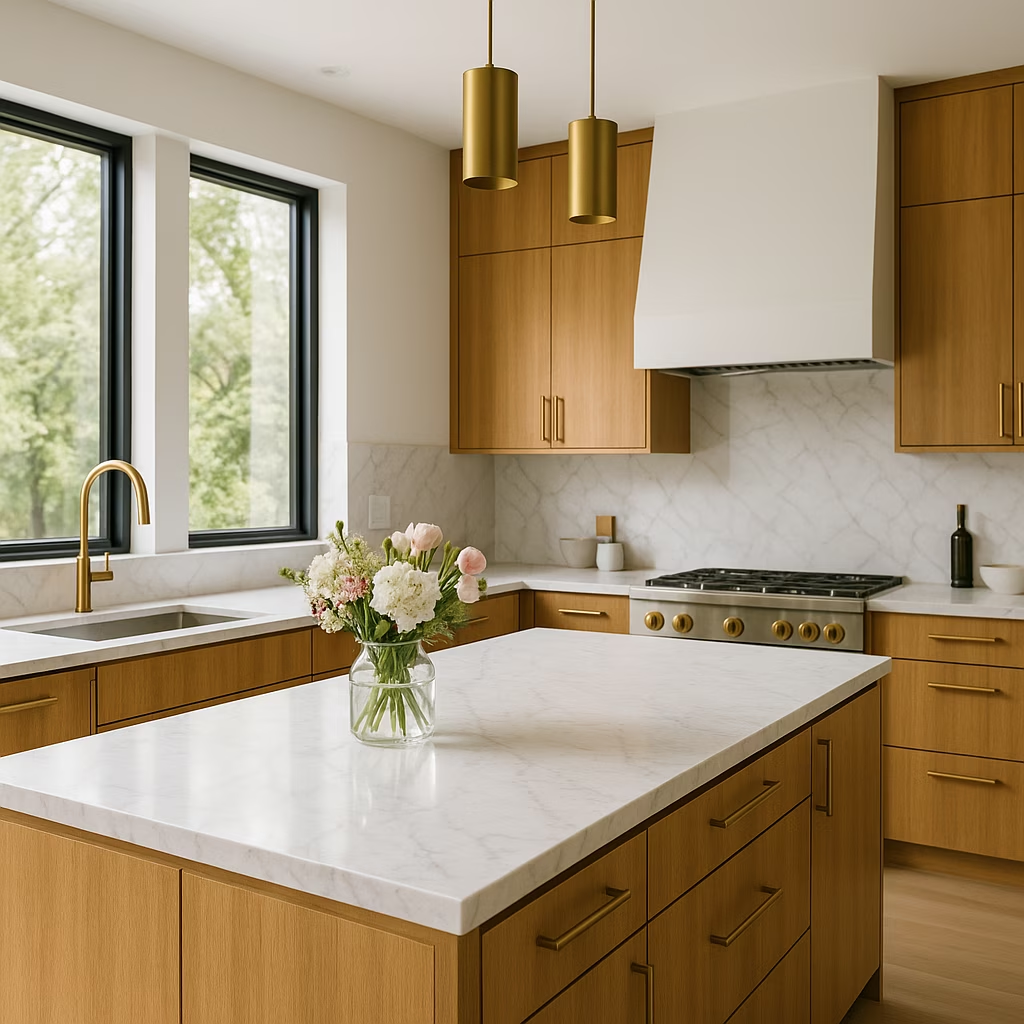
The greatest surprise on this list is often mistaken for safety. Stark, pure white countertops—ubiquitous in new builds and rentals—promise cleanliness but so often deliver a clinical, cold sterility that feels curiously outdated. It is a blankness that lacks soul, a void where character should reside. Yet, I cannot deny its power: it amplifies light, it expands space, it offers a pristine backdrop. The trick is to never accept its emptiness at face value. You must fill it with life. As Damla Turgut of Otto Tiles and Design wisely notes, the answer lies in natural materials that sing with variation. Think not of a flat plastic laminate, but of:
-
Carrara marble, with its soft, dimensional grey veining like whispers across a cloud.
-
Limewashed oak, offering texture and a warmth that pure white can only borrow.
-
Terrazzo, a playful confetti of chips suspended in a bright field.
For the renter bound to a sea of sterile white, designer Peter Spalding offers a poetic prescription: "Acknowledge the color, do not fight it." He suggests an icy, silvery blue palette, accented by light wood finishes and bold, abstract art in nearly-primary colors. A collection of colorful Le Creuset pots becomes not just cookware, but a vibrant installation art piece against that white expanse.
The Muddy Weight of Brown Granite
Oh, the brown granite of the 2000s and 2010s. It was meant to speak of earth and stability, but so often it tells a tale of rust and mud. Thomas Borcherding of Homestar Design Remodel pinpoints the issue: iron-rich granite with specks of quartz that can oxidize, leaving the surface looking perpetually stained, as if by a forgotten cup of tea. It is a color that can anchor a room—down, down, into the past. To lift it, one must build a world of light around it. The strategy is one of gentle contrast and intentional highlighting:
| Do | Don't |
|---|---|
| Use cabinetry in cream, oat, or soft beige. | Pair with dark espresso or black cabinets. |
| Choose wall colors that pull out the lightest flecks in the stone. | Paint walls a cool grey or stark white, enhancing the muddiness. |
| Incorporate reflective metals like polished nickel for brightness. | Use only oil-rubbed bronze or black hardware, deepening the gloom. |
This is not about disguising the countertop, but about framing it within a soft, neutral gallery so its own best qualities—perhaps a shimmer of mica, a warm taupe vein—can finally be seen.
The Overbearing Shout of Primary Red
Red is the color of passion, of danger, of a beating heart. On a countertop, a primary, unmodulated red can feel less like a heartbeat and more like a scream. "It is a very harsh color to balance," Turgut observes. "It dominates, it feels chaotic." It commands attention relentlessly, leaving little room for the quiet moments of a kitchen's life. But the spirit of red—its warmth, its vitality—can be invited in through more nuanced ambassadors. Seek out:
-
🌿 Earthy terracotta, which carries red's warmth but roots it in the clay of the earth.
-
🍷 Deep burgundy or maroon, opulent and night-like, absorbing light rather than reflecting it harshly.
-
💎 Veined marble with whispers of rose or rust, where the red is a secret, not a proclamation.
For those saddled with a bright red laminate, the salvation lies in the surroundings. Paint the cabinets a warm, soft neutral—think greige or a creamy off-white. This creates a calming envelope, a deep breath that contains the red's energy without stifling it. Introduce natural wood elements and simple, clean-lined hardware to ground the space.
The Dull Fade of Mustard Yellow
Nostalgia tints this hue, recalling cozy 1990s kitchens filled with the smell of baking. But mustard, magnolia, and Tuscan yellow on a countertop today can feel dull, sallow, and unflattering against our modern preference for subtlety. The challenge is its muddy undertone, which can cast a pall over everything placed upon it. To modernize and elevate, one must lean in, not away. "Color-drench the space," Turgut advises. Envelop the room in a cohesive, warm-neutral palette that makes the countertop a participant, not an outlier. Think:
-
Walls in stony yellows, mushroom, or taupe.
-
Cabinetry in a complementary warm white or gentle grey-green.
-
Hardware in aged brass or brushed bronze—the antique finish adds elegance and context, stopping the palette from feeling like a period piece.
Avoid cool blues and grays at all costs; they will fight with the yellow's warmth and highlight its less flattering aspects. This is a symphony of warmth, from the countertop up.
The Misplaced Zest of Bright Green
Here is the greatest irony: green, the color of nature and renewal, perennially chic on cabinets and walls, can feel utterly misplaced as a bright laminate countertop. Borcherding is firm on this: it has no business there, especially in a synthetic, uniform shade. It feels less like a fern frond and more like a leftover from a retro diner. Yet, the longing for that soothing, organic hue is understandable. The solution is, again, in the materiality. A green-veined marble or a deep forest granite brings the color in with complexity, depth, and a story written by geology. Borcherding offers a crucial caveat: making an eccentric color like green work requires flexibility elsewhere. "You need a cabinetry line that offers dozens of color selections, or custom colors," he states. Stock options with limited palettes will never provide the perfect, nuanced shade to create harmony. It is a commitment to a fully custom, considered look.
In the end, my journey through these kitchens teaches me that no color is inherently beyond redemption—only misunderstood or poorly accompanied. The countertop does not exist in isolation. It is a line in a poem, a note in a chord. By surrounding a loud color with quiet neutrals, by trading a flat laminate for a textured stone, by acknowledging the past and then deliberately building a bridge to the present, we can transform the tacky into the tailored. The kitchen regains its soul, not through rejection, but through thoughtful, poetic reconciliation. It becomes a space not defined by a single, shrieking color, but harmonized by a symphony of considered choices, where every element, even the most challenging, finds its rightful, beautiful place.