
In recent years, the concept of open living rooms has undergone a fascinating transformation, moving away from the vast, seamless expanses that dominated the past two decades toward more intimate, purpose-driven spaces. As of 2025, homeowners increasingly crave a delicate balance between easy entertaining and private retreats, reflecting a broader societal shift toward personalized comfort. For instance, as a professional game player, one can't help but appreciate how a zoned living area enhances focus during intense gaming sessions—imagine the tranquility of a dedicated corner where the chaos of open layouts fades away, replaced by a cocoon of concentration and immersion. This evolution isn't about abandoning openness entirely but redefining it to foster both connection and solitude, making homes feel less like cavernous halls and more like harmonious sanctuaries. 🌟
Designers like Melanie Grabarkiewicz from Meadowlark Design + Build have observed this trend closely, noting that while open plans remain popular for gatherings, there's a growing emphasis on creating distinct zones. 'Instead of one large, continuous area, people are asking for cohesive layouts that allow rooms to flow into each other, while still feeling purposeful,' explains Jeff Andrews, principal designer at Jeff Andrew Design. Isn't it intriguing how our desire for flexibility stems from the need to mentally shift gears? For gamers, this means having a secluded nook for strategy games without distractions from the kitchen or living area, evoking a sense of personal empowerment and calm. 😊 To achieve this, experts recommend subtle definitions through elements like:
-
Ceiling treatments: Such as beams or dropped ceilings to visually separate spaces.
-
Furniture arrangements: Using sofas or bookshelves to carve out cozy reading corners or home offices.
-
Area rugs: Adding warmth and boundaries, perfect for defining a gaming zone or meditation spot.
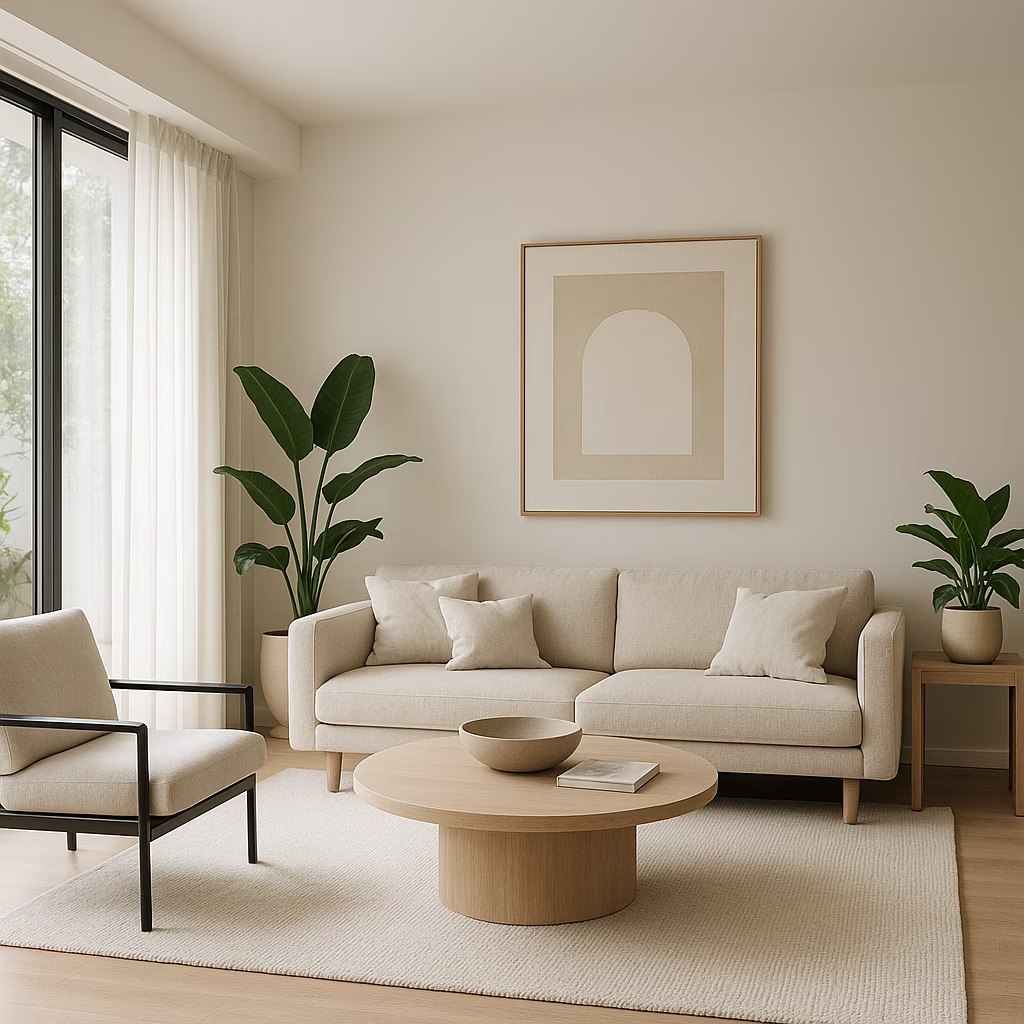 :max_bytes(150000):strip_icc():format(webp)/GettyImages-2195505277-5d3145b13c5d477c96d6495c79413e8a.jpg)
This shift is particularly evident in remodels of older homes, where formal dining rooms are often repurposed into multifunctional spaces. Grabarkiewicz shares, 'Even now, most homeowners still want that sense of connection—being together in the same general space, even while doing different activities.' But what does this mean for daily life? For someone immersed in gaming, it translates to seamless transitions—perhaps a shared beverage area bridging the living room and a gaming station, fostering camaraderie without sacrificing privacy. The emotional resonance here is palpable; one might feel a surge of relief knowing that family movie nights coexist peacefully with solo gaming marathons, all within a single, intelligently designed environment. 🎮
To illustrate the differences, consider this comparison of design approaches in 2025:
| Feature | Traditional Open Layout | Modern Zoned Design |
|---|---|---|
| Space Definition | Minimal barriers, high ceilings | Subtle divisions with partial walls or built-ins |
| Functionality | Single-purpose for gatherings | Multi-zoned for activities like gaming or work |
| Emotional Impact | Can feel overwhelming or impersonal | Promotes intimacy and focus, reducing stress |
Andrews emphasizes that 'the best designs today balance flow with structure, creating movement that naturally guides you through the home while maintaining synergy.' This philosophy resonates deeply with gamers, who often seek rhythm in their spaces—think of how a well-placed bookshelf not only stores collectibles but also signals a shift from socializing to serious play. :max_bytes(150000):strip_icc():format(webp)/GettyImages-1314299377-6cfe226c0754404cbfea09b1a5d5a1d6.jpg)
As we navigate this era of reimagined living rooms, the question arises: What lies ahead for home design? Will emerging technologies like augmented reality further blur the lines between physical and virtual zones, or will we see a resurgence of enclosed spaces for deeper privacy? For gamers, the possibilities are thrilling—could future homes integrate AI-driven partitions that adapt to our moods, creating instant gaming sanctuaries at the touch of a button? Ultimately, this trend isn't just about aesthetics; it's a reflection of our collective yearning for balance in an increasingly connected world. How will we continue to evolve our spaces to nurture both community and individuality? 🤔